
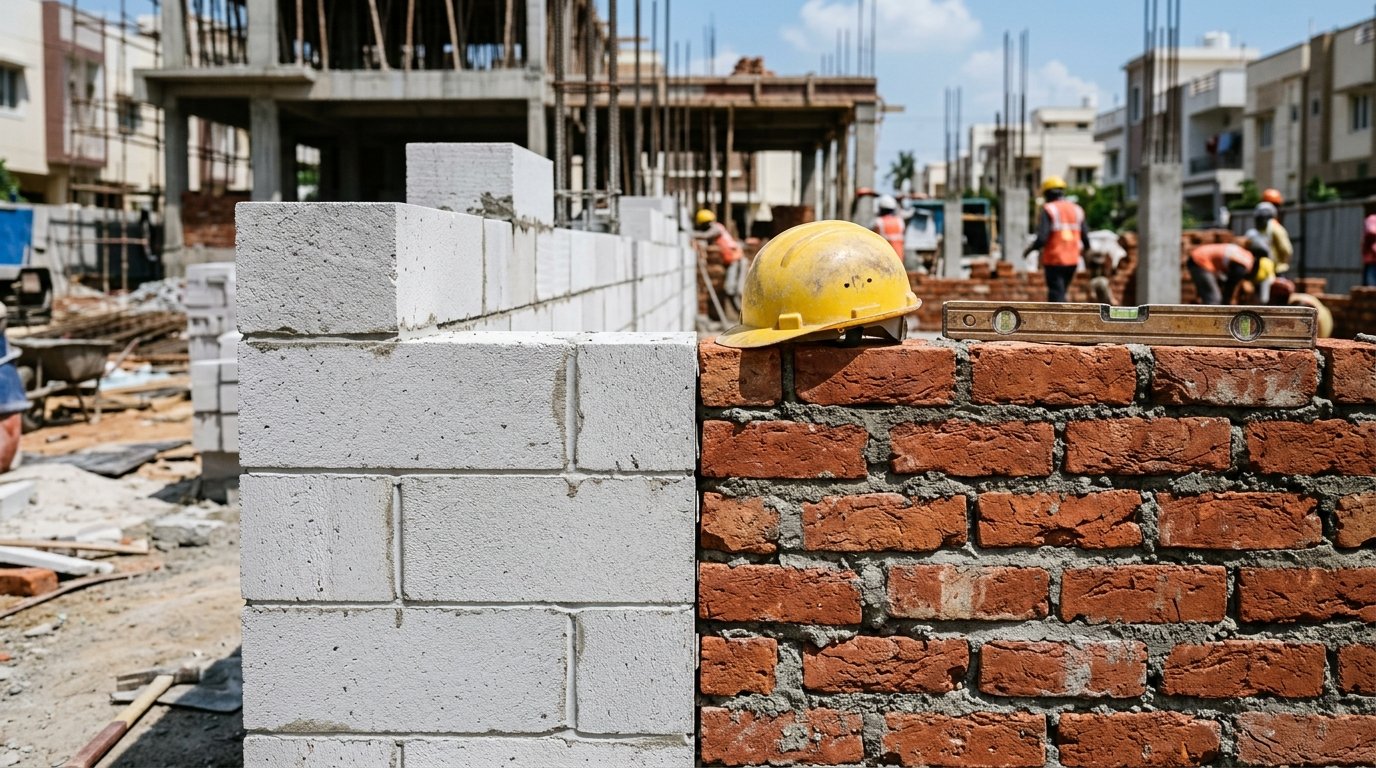
Walls are one of the first big material decisions in any house project, and the choice usually comes down to one question: AAC blocks or red bricks, which is better? Red clay brick has built Indian homes for generations. Autoclaved aerated concrete (AAC) is the lighter, newer option now common in cities. The honest answer depends on your climate, budget, structure and the masons available to you.
This guide compares the two on cost, strength, weight, insulation, durability and practical site issues, using 2026 price data and Indian Standards, so you can pick the best wall material for your house construction.
| Factor | AAC Blocks | Red Bricks | Better Choice |
|---|---|---|---|
| Material cost per unit | Higher | Lower | Red bricks |
| Total walling cost | Slightly higher (see below) | Slightly lower | Red bricks (narrow gap) |
| Weight of wall | Very light | Heavy | AAC |
| Heat insulation | Excellent | Moderate | AAC |
| Unit strength | Adequate for infill | Higher in good grades | Red bricks (on paper) |
| Speed of construction | Faster | Slower | AAC |
| Moisture and ground contact | Needs protection | More tolerant | Red bricks |
| Availability in small towns | Limited | Widespread | Red bricks |
How We Researched This Guide
We compared 2026 cost and specification data from several construction publishers, a supplier price guide updated in April 2026, a material price tracker updated in August 2026, and technical pages that cite Indian Standards. These sources frequently disagree, especially on prices and mortar savings, so we show ranges and flag outliers instead of picking the most flattering number.
What Are AAC Blocks?
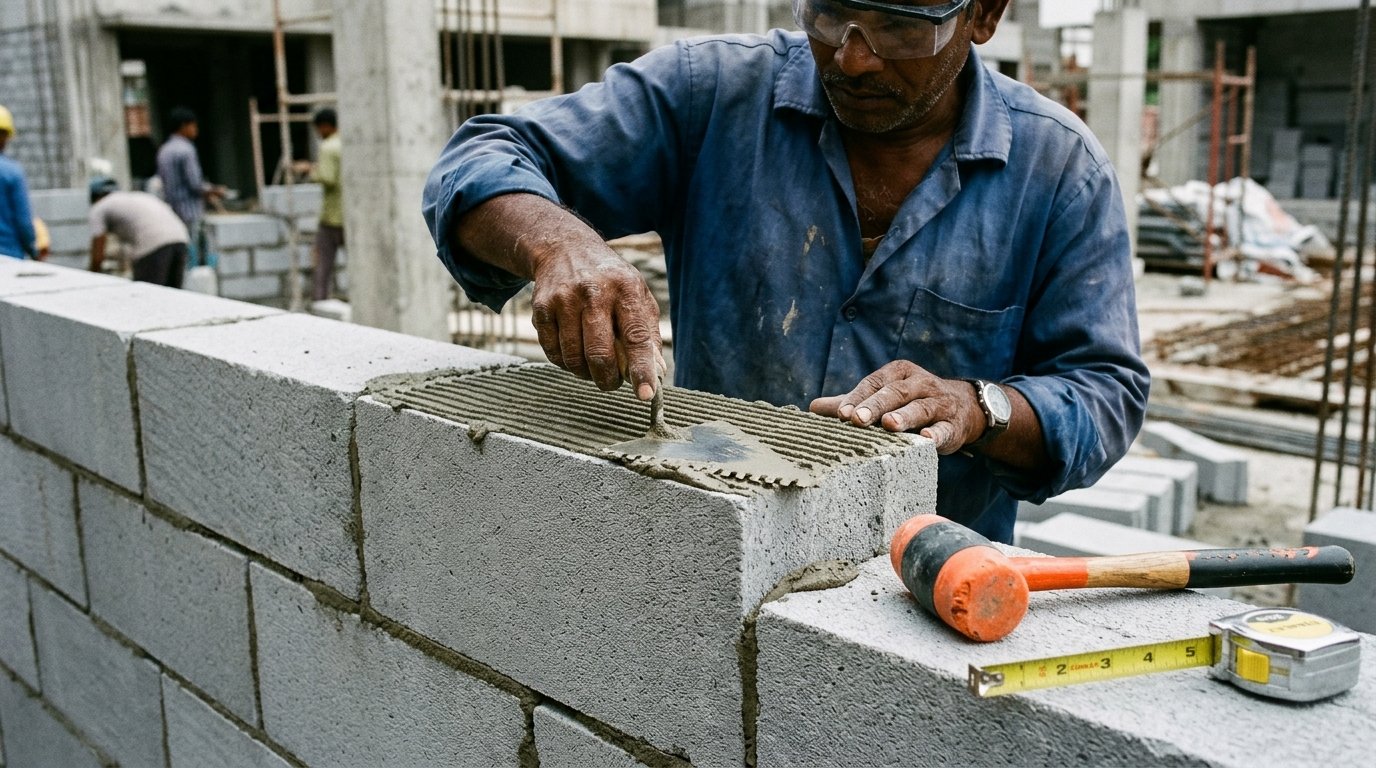
AAC blocks are lightweight precast blocks made from cement, sand or fly ash, lime, water and a small amount of aluminium powder. The powder creates tiny gas bubbles, so the finished block is 50–80% air by volume, and it is then steam-cured in an autoclave. Blocks are covered by IS 2185 (Part 3) and are usually 600 mm long and 200 mm high, in thicknesses of 100, 150 or 200 mm. They are laid with a thin-bed polymer adhesive instead of a thick sand-cement mortar bed.
What Are Red Bricks?
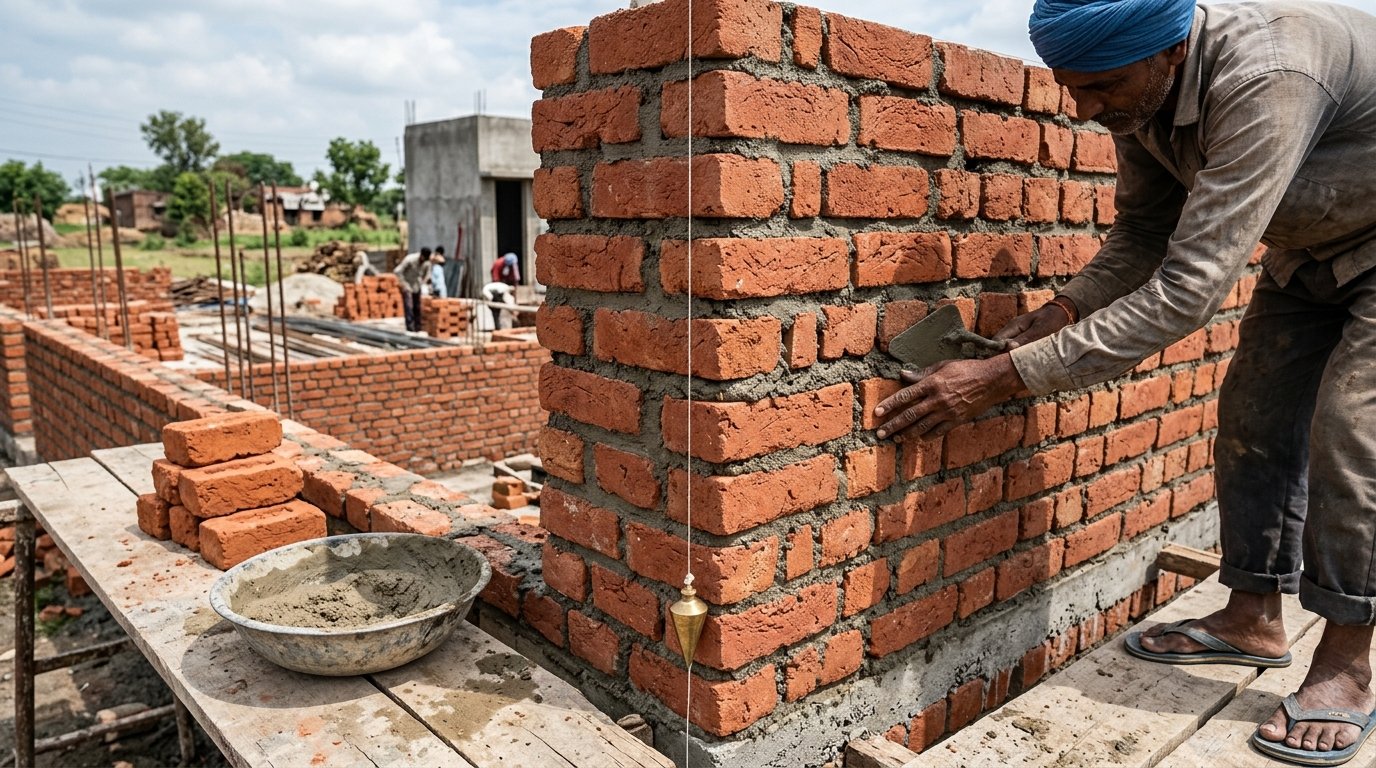
Red bricks are clay bricks moulded and fired in a kiln at roughly 1,000–1,200°C. Common burnt clay bricks are covered by IS 1077 and are graded by compressive strength classes. Standard sizes are about 190 × 90 × 90 mm (modular) or 230 × 110 × 70 mm (traditional). They are laid in cement-sand mortar, typically with a thicker mortar bed and thicker plaster than AAC.
AAC Block vs Red Brick Cost in 2026
Price per Unit
- Red clay brick: Most 2026 sources put it at about ₹8–12 per piece (₹8,000–12,000 per 1,000), though some regions are much cheaper, in the ₹5–7 range.
- AAC block (6-inch, 600 × 200 × 150 mm): A supplier guide from April 2026 lists ₹80–95 per block in Delhi NCR, and ₹72–85 in Lucknow. Other sources quote lower figures of ₹40–60, depending on block size, city and transport distance.
Because a single AAC block is roughly 13 times the volume of a traditional brick (600 × 200 × 200 mm versus 230 × 110 × 70 mm), comparing per-piece prices is misleading. The fair comparison is cost per square foot of finished wall.
Cost per Sq Ft of Wall
| Source (2026) | Red Bricks | AAC Blocks | Notes |
|---|---|---|---|
| HouseYog (Feb 2026) | ₹55–75 | ₹60–80 | Material + labour |
| Balaji Builds (2026) | ₹80–120 | ₹95–140 | Higher-cost estimate |
Both sources agree on the direction: AAC walling is typically ₹5–20 per sq ft more than red bricks. One source claims AAC is cheaper once mortar is included, but its figures are unsourced and we treat it as an outlier.
Worked example
HouseYog's example uses 3,000 sq ft of wall. At ₹65 per sq ft (red brick), walling costs ₹1.95 lakh. At ₹70 per sq ft (AAC), it costs ₹2.10 lakh. That is a gap of about ₹15,000, which is under 1% of a ₹24 lakh house.
With the higher-cost estimates, the gap rises to roughly ₹45,000–60,000, still only about 2–2.5% of that budget.
Where AAC Recovers Its Higher Price
Why Red Brick Prices Are Rising
A price tracker updated in August 2026 reports red clay brick prices rising roughly 10–15% a year since 2022, as several states restrict clay mining. That narrows AAC's price gap over time.
AAC Block Strength vs Red Brick Strength
| Property | AAC Blocks | Red Bricks |
|---|---|---|
| Compressive strength | Commonly 3–4.5 N/mm²; higher grades 5+ | IS 1077 classes start at 3.5 N/mm²; good first-class bricks reach 7.5–10+ |
| Dry density | About 450–650 kg/m³ | About 1,600–1,900 kg/m³ |
| Thermal conductivity | About 0.16–0.25 W/mK | About 0.6–1.0 W/mK |
| Water absorption | About 10% (maximum under IS 2185 Part 3) | About 12–20% |
| Fire resistance | Non-combustible; up to about 4 hours depending on thickness | About 4 hours or more depending on thickness |
| Sound insulation | Up to about 42 dB, depending on thickness | Good, mainly from mass |
Published figures vary between sources. Use these as typical ranges and check the manufacturer's test certificate for the product you buy.
How to Read These Numbers
On paper, a good red brick is stronger than an AAC block, and some sources even disagree on which is stronger. But unit strength is not the whole story. In modern homes, the load is carried by an RCC frame of columns and beams. Walls are infill, and they mainly need to carry their own weight, resist wind and stay stable. AAC at 3–4.5 N/mm² is generally adequate for that role. For load-bearing masonry, especially beyond one or two storeys, use a design from a structural engineer and check the required strength grade.
Weight and Heat: A Quick Calculation
Using typical densities and conductivities (our own approximate calculation, excluding plaster and mortar):
A 230 mm red brick wall at 1,800 kg/m³ is about 414 kg per sq m.
A 200 mm AAC wall at 600 kg/m³ is about 120 kg per sq m.
The AAC wall is roughly 3.5 times lighter.
Red brick is about 0.23 ÷ 0.9 ≈ 0.26 m²K/W.
AAC is about 0.20 ÷ 0.20 = 1.0 m²K/W.
The AAC wall resists heat flow roughly four times better.
That lower weight also matters in earthquakes. Seismic forces under IS 1893 are tied to the weight of the building, so lighter walls reduce the forces the structure must resist. Seismic design and detailing still need to follow IS 1893 and IS 13920.
AAC Block Advantages and Disadvantages
Advantages
- Very light, which reduces structural load and makes handling easier.
- Excellent thermal insulation, which helps in hot climates.
- Uniform size (tolerance of about ±1.5 mm), which gives straighter walls and thinner plaster.
- Faster AAC block construction, with fewer joints and less mortar.
- Lower water absorption than most clay bricks.
- Non-combustible and good sound absorption.
Disadvantages
- Higher material cost and slightly higher labour rate.
- Porous: exposed external walls need good plaster, a protective coat or paint, and waterproofing. Long contact with rain or wet backfill can reduce strength.
- Smooth surface makes plaster adhesion harder; use the manufacturer's recommended bonding method.
- Heavy fixtures such as wall-mounted TVs or geysers need special anchors, not ordinary nails or wall plugs.
- Needs masons familiar with thin-bed adhesive; poor workmanship causes cracks at joints.
- Limited availability and higher transport cost in smaller towns.
Red Brick Advantages and Disadvantages
Advantages
- Lower upfront cost per unit and easy availability almost everywhere.
- Familiar to local masons, so workmanship quality is easier to find.
- Strong in good grades and tolerant of ground contact, plinths and boundary walls.
- Easy to fix fittings into.
- Long track record, with traditional masonry lasting many decades when maintained.
Disadvantages
- Heavy, which increases dead load and foundation demand.
- Moderate insulation, so rooms heat up faster in summer.
- Quality varies from kiln to kiln; always test samples.
- More mortar and thicker plaster, plus slower laying.
- Efflorescence (salt deposits) can appear if poor bricks get damp.
- Kiln emissions and clay mining raise environmental concerns, and several states restrict clay extraction.
What About Fly Ash Bricks?
Many buyers also consider fly ash bricks as a third option. A 2026 comparison puts them at about ₹5–8 per piece, with total walling cost slightly below red bricks, uniform shape and lower mortar use. Their performance can vary between manufacturers, so check strength and water absorption certificates before buying.
AAC Blocks for Residential Construction: Where They Work Best
- Multi-storey homes and apartments, where lighter walls reduce structural load.
- Hot and mixed climates, where insulation lowers cooling costs.
- RCC-framed houses with infill walls.
- Projects with tight timelines, since faster laying shortens the schedule.
- Seismic regions, as part of a design done by a structural engineer.
Where Red Bricks Still Make Sense
- Plinth walls and walls in contact with the ground, where moisture exposure is highest.
- Boundary walls, compound walls and exposed areas.
- Small towns and remote sites where AAC supply is limited or expensive.
- Low-rise load-bearing construction, when designed and checked by an engineer.
- Projects with the tightest upfront budgets and experienced local masons.
A Practical Hybrid Approach
Many homeowners use both materials: red or fly ash bricks for the plinth and ground-contact walls, and AAC blocks for upper walls and external walls where insulation matters. This is a practical approach, not a rule, and it works best when your engineer and contractor agree on the detailing at the junction.
Mistakes to Avoid When Using AAC Blocks
- Skipping the thin-bed adhesive and using thick sand-cement mortar.
- Leaving external walls unprotected from rain.
- Ignoring the junction between AAC walls and RCC columns or beams, where cracks commonly start. Ask the contractor how it will be detailed.
- Planning heavy fixtures without special anchors or embedded supports.
- Buying uncertified blocks. Ask for test reports for density, strength and water absorption (IS 2185 Part 3, IS 3495).
Which Is Better: AAC Blocks or Red Bricks?
Choose AAC blocks if you are building an RCC-framed house in a hot or mixed climate, want faster construction and lower dead load, can find skilled masons, and can accept a small increase in walling cost.
Choose red bricks if you are in a small town with limited AAC supply, are building ground-contact or boundary walls, want the lowest upfront cost, or are working with a traditional load-bearing design.
For most urban and semi-urban homes in 2026, the cost gap is small, usually under 2–3% of the total build cost, so long-term comfort and structural load often matter more than the per-block price.
Final Verdict
There is no single winner in the AAC blocks vs red bricks debate. AAC wins on weight, insulation and speed, and the extra walling cost is small compared with the total budget. Red bricks win on upfront price, availability and tolerance of moisture. For many RCC-framed homes, using AAC above ground and red or fly ash bricks at the plinth is a sensible middle path. Whichever you choose, insist on certified material, proper workmanship and a structural design that follows Indian Standards.
Disclaimer
This article is for general information only. Prices and specifications vary by city, manufacturer and time, and sources disagree on several figures. Consult a licensed structural engineer and local suppliers before finalising materials. Figures reflect publicly available data up to October 2026.
Sources and References
Frequently Asked Questions
Q1Are AAC blocks better than red bricks?
For insulation, weight and speed, yes. For ground contact, small-town availability and lowest upfront cost, red bricks often win. The better choice depends on your project.
Q2Are AAC blocks stronger than red bricks?
Not per unit. Good red bricks have higher compressive strength, though common AAC grades (about 3–4.5 N/mm²) are adequate for infill walls in RCC-framed buildings.
Q3Are AAC blocks more expensive than red bricks?
Per unit, yes. Per sq ft of finished wall, AAC typically costs about ₹5–20 more. Savings on mortar, plaster, time and structure can offset part of that.
Q4Can AAC blocks be used in load-bearing construction?
Higher-strength grades can be, but it should be designed and approved by a structural engineer. Most homes use AAC as infill in an RCC frame.
Q5Do AAC walls crack?
Poor workmanship, wrong mortar or unprotected junctions can cause cracks. Using the proper adhesive and detailing at joints reduces the risk.
Q6Is AAC good for earthquake-prone areas?
Its light weight reduces seismic forces on the structure, but earthquake safety depends on the whole design under IS 1893 and IS 13920, not the block alone.
Q7Do AAC blocks reduce electricity bills?
They can, because of better insulation. One source claims 20–30% lower cooling cost, but that is not independently verified, and actual savings depend on orientation, windows and roof insulation.
Q8Can I hang heavy things on AAC walls?
Yes, but use fixings designed for AAC. Ordinary nails and plugs do not hold well.
Verified Industry Sources & Standards:

Sushil Kumar
Verified AuthorManaging Director & Founder • Vision Infra
Founder of Vision Infra, overseeing turnkey civil engineering, high-rise residential frameworks, road networks, and industrial infrastructure across Haryana & Punjab. Expert in structural costing, IS code compliance, and BOQ estimation.
Need Residential Structural Masonry & External Development for Your Site?
High-precision masonry laying, structural dead-load optimization, and durable external development works. Backed by our 100% self-owned machinery fleet and proven delivery at Urban Village Commercial Plaza.
Related Engineering Guides
 RCC & Structural
RCC Roof Slab Casting Checklist & Shuttering Guide: Step-by-Step IS 456 Rules
Complete step-by-step RCC roof slab casting checklist under IS 456: shuttering staging inspection, rebar cover blocks, electrical conduit layout, M20/M25 mix, vibrator technique, and pond curing schedule.
 Costing & Budgeting
1000 Sq Ft House Foundation Cost in India 2026: Complete Guide
1000 sq ft house foundation cost in India 2026: rates by foundation type, item-wise breakdown, quantities, soil effects and tips to save without risk.
 Costing & Budgeting
RCC Roof vs Metal Roof Cost for a 1,000 Sq Ft House in India (2026)
RCC roof costs ₹4.3–6 lakh and a metal roof ₹2.6–3.8 lakh for 1,000 sq ft in 2026. Compare cost, lifespan, heat, noise, and upkeep before you build.